
A FRIEND’S BROTHER is in memory care and he recently visited him for the first time. His impression?
“I wondered why he was in there. He carried on a perfectly normal conversation,” he said. “He told me ‘I won’t spend the rest of my life in here.’”
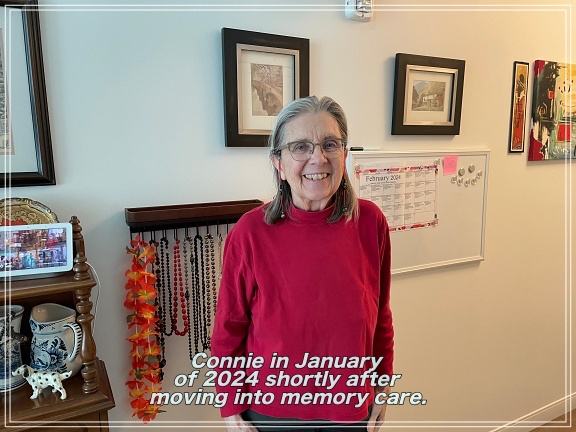
That’s not an uncommon experience in the earlier stages of any form of dementia. My wife, Connie, was like that. Yet, with her agreement, we went to memory care. And, from what I have seen in more than two years of spending serious time in a memory care unit, just about everyone in there at some level wants out.
My friend’s experience in seeing a loved one in memory care for the first time was not that unusual.
But here’s some advice for friends and family who have that experience: Don’t jump to the conclusion the person does not belong there.
The decision to move a loved one into memory care is a layered one and there are complexities unique to a family’s situation.
In our case we lived in a two-bedroom apartment in a large complex. To bring in home care to give me some relief was not as easy as it might sound with a need to get the help access to parking and through other layers of security. Also with an apartment, I’d have to get out if I wanted some time away and trying to plan that time with when help would be coming in was not easy. And, if I stayed in the apartment we’d be on top of each other.
That is what led to our decision and it was made with Connie’s involvement as well as that of Andrea and Seth. If I still had been in a house I well may have put the memory care center off, for a while. The space could have absorbed home health care workers. But we were not in a house.
Another consideration is the temperament of the partner who will be providing in-home care. In my case my temperament was fine, but someone else may not find that to be the case. In some cases the caregiver spouse or partner may have health issues of their own.
I admit to having more than one moment of doubt in the first six months Connie was in memory care. I wondered if we had acted too soon, but for the most part I put second-guessing in the closet. By the time we passed the six-month mark we were seeing decline. Connie began dropping down to a plateau, and then another and another until we find ourselves at today.
I guess the point of this post is to say that when family or friends make the decision to put someone in memory care, don’t judge. I know my friend was not really judging and he’s a caring guy so this isn’t a criticism. But his comments did spark a thought and took me back to when we made our decision.
The best thing you can do for someone who is facing and making these decisions is to be supportive, even if you personally question the decision. Trust me, a lot of thought, talk and tears went into that decision.
Rich Heiland, has been a reporter, editor, publisher/general manager at daily papers in Texas, Pennsylvania, Illinois, Ohio and New Hampshire. He was part of a Pulitzer Prize-winning team at the Xenia Daily (OH) Daily Gazette, a National Newspaper Association Columnist of the Year. Since 1995 he has operated an international consulting, public speaking and training business specializing in customer service, general management, leadership and staff development with major corporations, organizations, and government. He also writes the blog stuffonmymind.blog. Semi-retired, he and his wife live in West Chester, PA. He can be reached at [email protected].
Thank you for explaining and teaching this to people who are not dealing first hand with a loved one with dementia. It is hard enough to watch your “person” turn into someone else, someone who looks the same but isn’t at all the same, someone who becomes less and less competent and needs more and more help. It’s a sad and heartbreaking and exhausting and relentless march. Caregivers have very little bandwidth left to deal with what feels like criticism from friends and family, and sometimes medical professionals. Supportive listening is truly helpful. And so is spending several hours at a time with the caregiver and their person, to see first hand what the situation is. You are doing a great job for Connie, Rich. Hugs to you!!!