
Things Have Changed….
OUR ROUTINE HAS changed.
Once upon a time, when I left Connie’s memory care unit each night, I’d hug her, tell her I loved her and leave.
Now, I take her into the bathroom and I put the toothpaste on her electric brush, help her get it into her mouth and hand. While she brushes, I clean her glasses. These days the lens are covered with food, fingerprints. She no longer knows how to take them off by the stems.
After she has brushed, I take a manual brush and and give her teeth a once-over, then give her a bit of mouthwash to swish around.
Then we go to her bedside. I take her clothes off. She gets confused. She has lost her sense of balance so it is hard for her to disrobe, especially her pants and Depends absorbant pants, which are required now.
When she has disrobed I put her adult overnight diapers on then slip a nightgown over her head. I get her to lie down, get comfortable, then tuck the covers up around her chin, kiss her, tell her I love her and say goodnight, leaving her in the dark room.
Things have changed. The staff has told me she is at risk of falling but they don’t think she can manage a walker. They said they are checking on her more often and when the time comes for her to start using a wheelchair, they will see that she does.
Sanitation has become an issue. She no longer remembers the process of post-toilet time. One day I found her in a mess. I cleaned her up then ask why she did not ask the staff for help. She did not answer. I know why. She’s embarrassed.
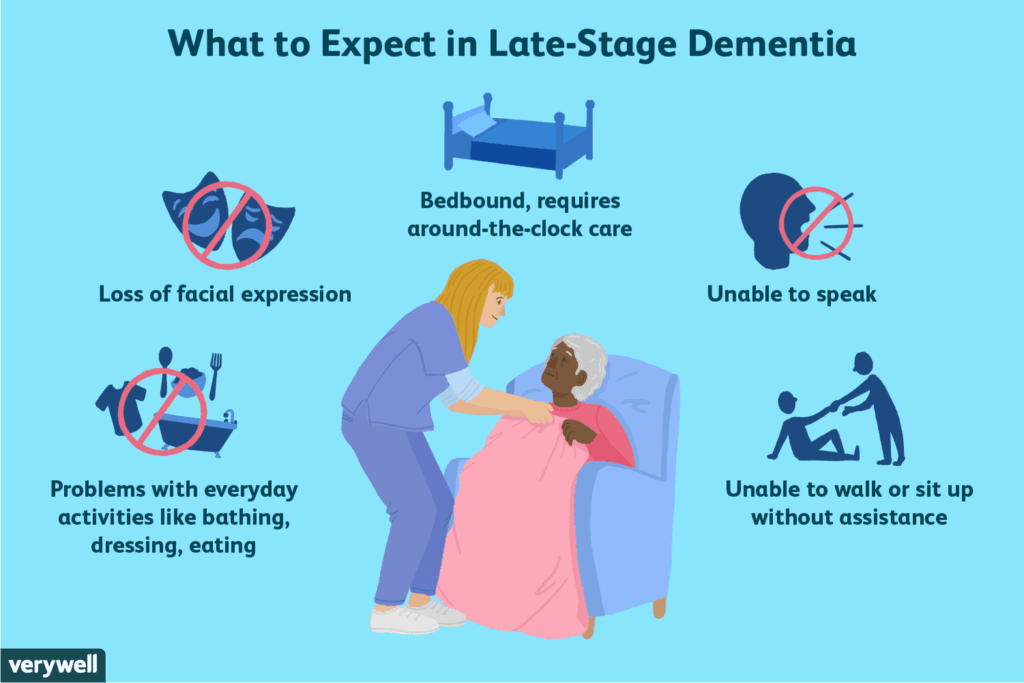
HER ANXIETY Is defeating the meds designed to lessen it. When she sits down at the dining table she takes a couple of bites, stands up and starts to head for her room. The staff has to corral her. Couple more bites, stands up. When we sit in her room watching television, she will suddenly stand up. I tell her to sit down and she does. For a while.
Carrying on a conversation is now in the past. The progressive speech aphasia that is a part of her Frontal Temporal Dementia has gotten her to the point where, even when she has a cogent thought, she can’t get it out. I nod a lot, say “that’s interesting” a lot and most of the time have no idea what she is trying to say. To get to a conclusion is now a quiz show with me asking “do you mean” and her answering if I get it right.
When I take her for a drive we walk slowing to the car, hand-in-hand. At the car she halts and waits for me to tell her what to do. She gets confused about how to get into the car. I have to hook up her seatbelt.
I went to a one-act play this past Sunday. As I watched I thought of Connie. Back in Piqua, Ohio, where we once lived, we were active in community theater. We did “Lion in Winter” and Connie played Eleanor. She was outstanding. My father – an actor, director, acting teacher – rushed back stage to gush over her performance. I can’t imagine a tougher critic. She deserved every bit of it. Now? She can’t speak.
This is our reality. It happens, sooner or later, to every family dealing with dementia. There is no escape so to get through the day, and night, there has to be acceptance, even if it is grudging. And, of course, there must be love and warm memories of what was.
Rich Heiland, has been a reporter, editor, publisher/general manager at daily papers in Texas, Pennsylvania, Illinois, Ohio and New Hampshire. He was part of a Pulitzer Prize-winning team at the Xenia Daily (OH) Daily Gazette, a National Newspaper Association Columnist of the Year. Since 1995 he has operated an international consulting, public speaking and training business specializing in customer service, general management, leadership and staff development with major corporations, organizations, and government. Semi-retired, he and his wife live in West Chester, PA. He can be reached at [email protected].
You and Connie are in my daily prayers. You are two of the strongest people I have ever met and I love you both.